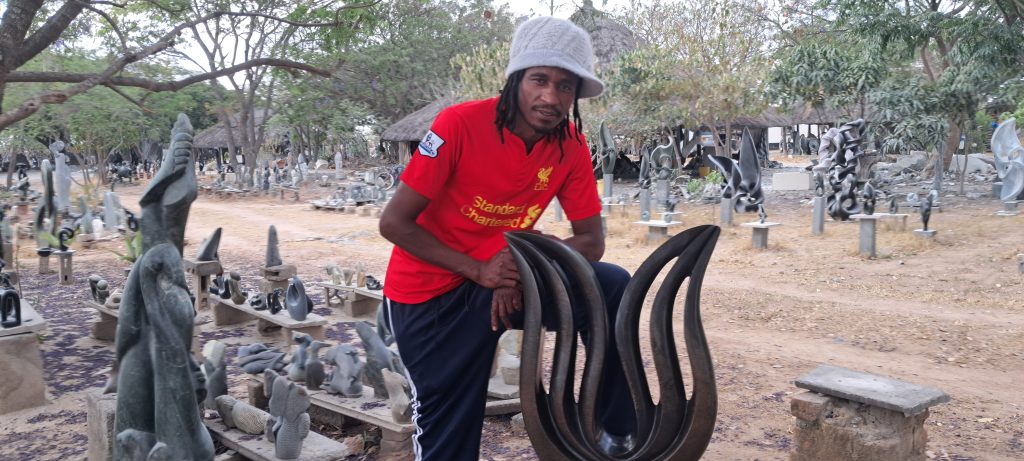
By Rukudzo Onai
As Zimbabwean sculpture evolves beyond its spiritually charged classical definitions, Owen Mlungisi is carving his niche as a therapy artist. Mlungisi is based at Chitungwiza Arts Centre, easily one of the most populous sculpture hubs in Southern Africa, with more than 200 artists trading hammer and rasper, shoulder to shoulder, in smoky sheds.
Six decades removed from “first-generation Shona Sculpture” – this was the formal term for a highly successful age of Zimbabwean art which was neither truly the first nor exclusively Shona – Mlungisi and his peers are marking their territory and making meaning in a globalized age. Where the early curators thought of themselves as workshopping raw talent to conjure African spirits into stone, new carvers give off a hybrid attitude – equal-parts totem pole and Mobius strip – and new consumers may not be so much anthropologically as they are geolologically enchanted.
A particular immersion in abstract art is balanced with figurative works steeped in family life and Zimbabwean customs. Abstraction is a balancing act in stone economy, stacking messages onto stripped-down stone matter.
It would be, however, a mistake to dismiss the popularity of abstract pieces among younger sculptors as a cultural whiplash. Key is to find how a creator picking up the hammer after a radical sea change in the market signs his own artistic vision, and what role, if at all, his cultural inheritance plays in that.
Mlungisi is a fascinating case study.
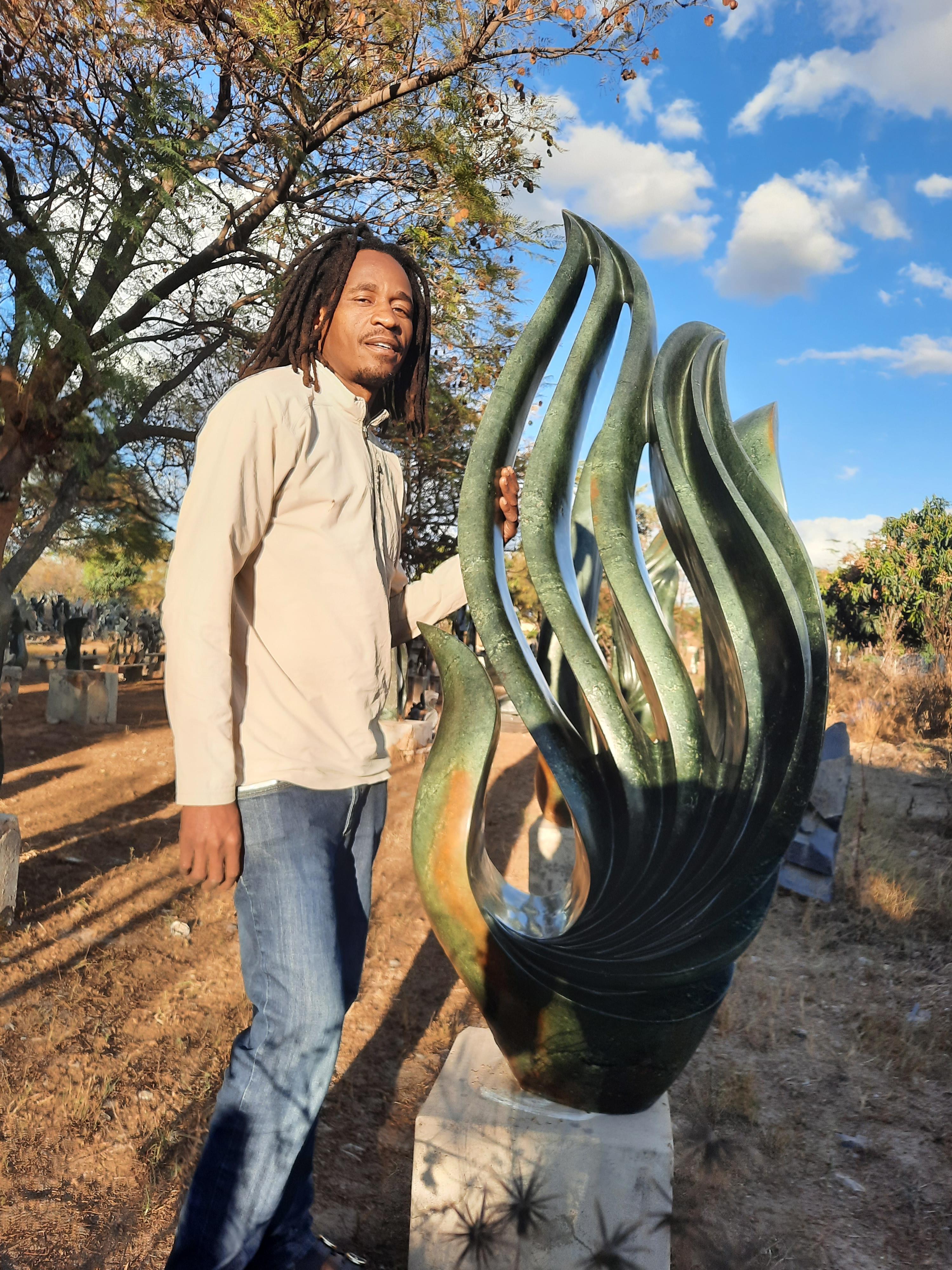
His signature artwork is the flame-lily, based on the flower which is Zimbabwe’s botanical symbol. Known as jongwe or gukurume – rooster – in Shona, the flower is shaped like a flame and somewhat bundles up colors of the Zimbabwean flag. Mlungisi’s performance does not insist on floral verisimilitude. Instead, he carves a flower that equally embodies, at the same time, within the same material its English name – the flame – and its Shona name – the rooster.
Mlungisi’s flame-lily has therapeutic properties, salutary to his background as a functional artist. Stone carvings polished to blend with the natural, without being obviously one animal, plant or element, nor the actual colors of the same, give off a healing vibe that one cannot quite isolate to one visual instance.
The choice of stone, ice-white dolomite from Rushinga, bottomless-black springstone from Mvurwi, and rich-green opal from Chiweshe, subtly tinges the affect. Zimbabwe’s Great Dyke, a geological belt that leaps province to province, is home to a family of stones whose whose fired properties give Zimbabwean sculptors a strong natural advantage.
Mlungisi mostly works in green opal, dolomite and springstone but also popular Zimbabwean stones like leopard rock, red jasper and verdite. At Chitungwiza Arts Centre, some stones are rarer while others are only getting thrown into the mix.
Mlungisi was born on September 21, 1984. He grew up in Hippo Valley, Chiredzi, where he obtained his A Level in commercial subjects. He took gap years in the mid-2000s, dividing time between Zimbabwe and South Africa. In 2006, he joined his uncle Gladman Zinyeka, now based in Domboshava, as an apprentice at Chitungwiza Arts Centre.
“My first pieces were mostly elephants and birds. This was in 2008 when I started standing on my own,” Mlungisi shared his journey. This weaning stage corresponds with the two years artists are required to take as probationary artists at Chitungwiza Arts Centre before they become full members.
In the intervening period, Mlungisi sold his first piece via an Alliance Francais exhibition in Harare.
“Later on, I did an exhibition with my brother, Felix Mlungisi, at Tina Skukan Gallery in Pretoria, South Africa, and sold some pieces.”
After those early experiences, Mlungisi sat for a certificate in functional art with Fair Trade Designers of Denmark in 2013. He subsequently worked as a curator for AfriGarden Gallery at Dome Estate, while also perfecting his own art. At the time, he mostly worked in green opal, springstone and verdite.
In the early years, Mlungisi figuratively expressed his preference for nature-themed pieces for the most part, especially since that was the form his kinsmen worked in under his tutelage.
In time, he moved the healing claims of his to the abstract. “I do therapy art and these days, it’s mostly in abstract,” Mlungisi explains. With his literal stone garden, you are looking at art shaped to absorb the beholder into nature and deep time, with life in so far as it precedes and exceeds him.
Looking at Mlungisi’s masterpiece, an isolated petal on the right side of the flower convincingly works as the head – and neck – of a bird. The main flower has the look of tongues of fire, and equally of a bird’s tail blowing in the wind. As a bird, Mlungisi’s signature piece is stripped down to head and tail, a bird without wings, which is one way to see the bird of dawn.
He now trades from Chitungwiza Arts Centre where he has maintained a presence between different exposures and experiments.
The location of the Arts Centre in Chitungwiza, based on a joint arrangement by the United Nations and the Government of Zimbabwe in 1997 is significant. Chitungwiza is the culturally pre-eminent city of Zimbabwe, with the possible exception of Bulawayo and Harare. Its name comes from “dungwiza,” land of tall grass, historically attributed to Chaminuka, the great prophet of Zimbabwe.
The talent at the centre includes children and understudies of the famous “first generation,” and walk-in journeymen across age groups. Cultural attitudes at the Centre miniaturize a city which is itself a hybrid of indigenous Zimbabwean belief adapted to the struggles of township life, formal education and the missionary aftermath. Salutary to the new art force, the younger generation of buyers is more open to the young artists’ navigation of global changes.
INTERVIEW: “Follow the Stone”
Onai Mushava: So, therapy art works best in abstract?
Owen Mlungisi: That’s the usual medium.
Onai: When we talk about something abstract, it’s something I am directly engaging with, the piece itself, without an exact reference of it in the real world?
Owen: Yes, the piece itself. It got to be beautiful and singular enough to draw your brain to it. In a way, it’s directing you away from the world rather than referring you to it.
Onai: Perhaps that’s the everyday struggle it’s drawing me away from, facilitating an escape into nature? When I look at your piece, I see a flower, a bird, and a flame in the very same material.
Owen: Yes, that’s the flame-lily. We find medicine in plants. We find the breath of life in plants. We find natural refreshment in plants. I translate in a minimal but also complex way with the combined elements you mention in your question.
Onai: You are abstracted from nature. And nature makes you total again?
Owen: Yes. The stone itself is part of your healing. It comes with its own qualities and properties.
Onai: Because it’s abstract, it’s not a flame-lily as such. It’s almost a different proposition of what a flower is. And the colors for me pose an aporia. What can I say. The flowers and the colors you match up with further challenge my idea of what a flower can be.
Owen: I hear you well. When you start thinking, what type of flower is this color giving me, and that is just a stone shining off its hidden qualities, negotiating its own complexity without interrupting your experience of nature, that’s where you get lost, and that’s where healing begins.
Onai: But it’s a nature that you are abstracting, interupting, mediating, packaging, or repackaging for me.
Owen: The artist’s job is interpreting.
Onai: And this interpretation must be carried out without interruption, without removing you from an experience of nature, so to speak?
Owen: The way a sculptor does that, the mantra we use is: Follow the stone. It means I follow the shape or movement of the stone when creating. That’s why the carvings even come out different artistically, one hidden motivation is the real limits and possibilities the raw stone imposes on you as you create. If I make five sculptures, all of them are different because I am using the shape of the stone. The stone is nature, and nature is affect, something older than what you can ever translate into language. Let me just by following the stone, you are letting it relay the oldest language there is to the soul of the art consumer.
Leave a Reply