By Rukudzo Onai
Arthur Manyengedzo is a pioneering member of Chitungwiza Arts Centre. He joined the reputed workspace in 1998, a year after its inception, following brief apprenticeship with his aunt Locadia Ndandandarika. Manyengedzo (AM)‘s work has been exhibited in Belgium, Canada and China. He speaks to Rukudzo Onai (RO) on his art experience and more recent work.
RO: You mention a predicament that your art has a bigger footprint outside the country than it has home? Has this ever changed for visual artists?
AM: On government level, the arts ministry gave us the space we work in. We have also seen ministers and the presidium visit this place in recent years. There are tell-tale signs that visual arts could play a bigger role in national development.
RO: Having been to Europe, America and Asia with your sculpture, do you think institutions recognize visual art more than the general populace?
AM: Our art is highly regarded by institutions around the world. The reception I got as a visiting artist was too good to be true.
RO: You are my big homie from Gutu. Coming to Chitungwiza, one big creative city if ever there was one, do you think putting my carving skills on the table is a convincing way to chat up a sister in the hood.
AM: Hahaha.
RO: I mean, back in the 1980s, the biggest musician, Leonard Dembo, had to tell his fiance a different name, and tell her family that he was gainfully employed at United Bottlers to escape the stigma associated with being an artist. If you were a musician today, you would be a god among men. Have the social fortunes of the sculptor equally improved?
AM: The reason why I brought up institutional recognition is, I believe the support of government and corporates could take us much further than we are now. As a community arts project, though, we could use a lot more support from our communities. Until visual art is celebrated more at home, it will benefit other economies more than ours.
RO: Right! If you could walk me through your garden, tell me more about your latest artworks.
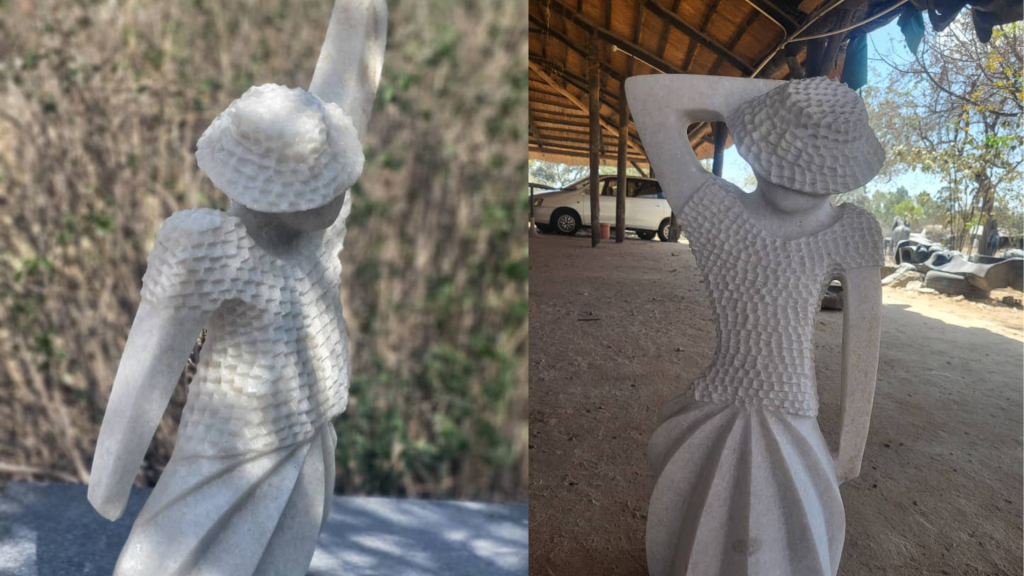
AM: The first piece (pictured) is called “On a Fashion Day.” The good lady is showcasing her madhoiri drip, which is African attire but also very modern. You can see the bucket here, the whole style, channeling a modern vibe off proudly African fabric.
The second piece is about “Patience.” The man is waiting patiently:
RO: That would be for money?
AM: I don’t know exactly what he was promised. The other piece is also about showcasing African pride. This one is…
RO: Lovemaking.
AM: Yes; these ones are in their own world. And then this one is about a woman waiting in hope. You could picture her as a daughter in law. Her gesture tells you what she met in her new home may not be quite to her liking. But it’s also her home and she got to be a woman.
RO: I like how one gesture makes the daughter-in-law both newcomer and landlady. Would you like to share on your technique. One might think of dolomite as an undifferentiated white mass. You find a way to give the piece internal variety with patterns here, smooth finish there.
AM: The way you use texture brings uniqueness to your piece. The theme may be the same but the challenge is always to express it different.
Leave a Reply