By Andrew Chatora
Samantha Rumbidzai Vazhure is a Zimbabwean-born renaissance woman. Head honcho at the UK-based Carnelian Heart Publishing, she is an equally able lawyer, novelist, poet, sculptor and painter. With creatives who shine across multiple genres, I am usually tempted to approach poetry as the mystery key that gives character to the other offices. It was from this superstition that I took up her award-winning 2022 poetry collection, Starfish Blossoms, to find the key.
“Do mermaids smoke seaweed?” the surreal question asked by a little girl in of the pieces was the first to jump out to me. Casually posed as a poem title, the question of coochie-afro mermaids puffing on some high-grade evergreen spliff – blue mushrooms of smoke bubbling away into the Lake – is a beautiful one. Identified as the Vazhure’s daughter, the little one is equally the daughter of mermaid, for that is the poet’s Lake totem. Looking at the women who have come into the world before her, the little one might be looking into the great drama of survival or, perhaps, looking past it.
The creatures of her rabbit hole have gone beyond the singular art of breathing under water. They go so far as to create own reality, nervous conditions notwithstanding. If all the world is a stage as the Old Bard said, sister mermaids who make good on the weed in seaweed take sob lines in a stride as in a Yeatsian “drama for dancers.”
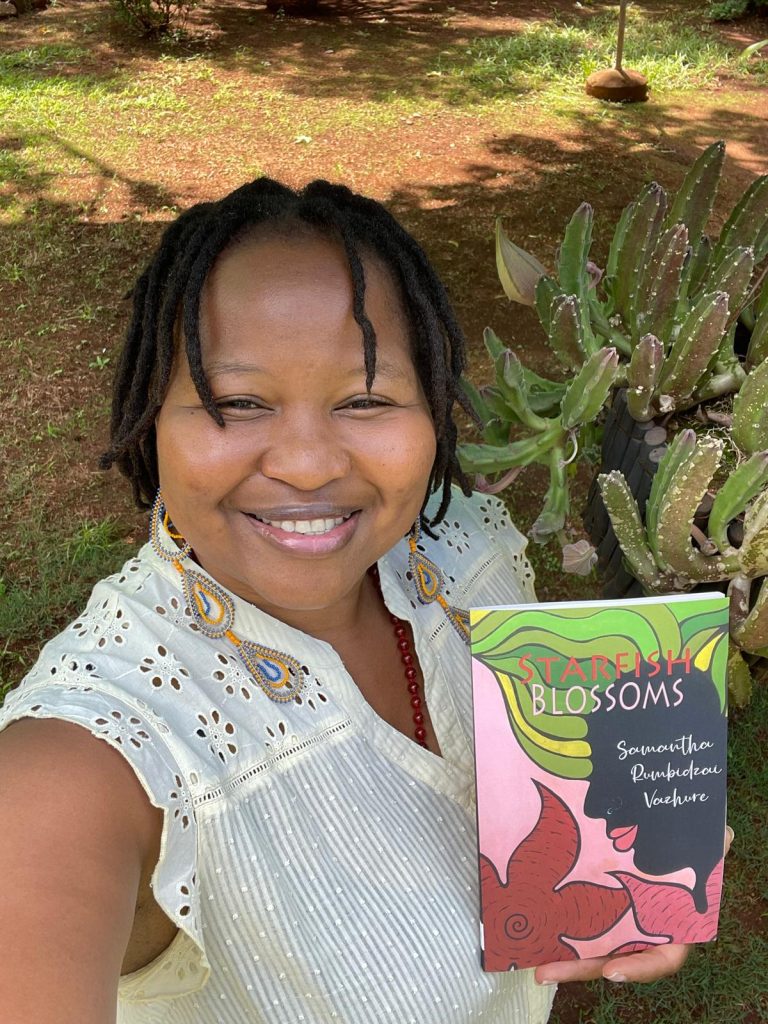
Starfish Blossoms is Vazhure’s first poetry collection in English, with the technical exception of Uprooted, originally published in Shona as Zvadzungwa Musango. The surreal cover art of her latest collection with ultra-black face, green wavy hair and two starfish in the detail, has to be one of the most beautiful in Zimbabwean poetry. I would boldly place it next to the ambitious artwork for Country Dawns and City Lights (1985) by Musaemura Zimunya, another renaissance figure who moonlighted as a manager of Chimurenga Music Company. The cover art is the work of Joanna Swan. A workhorse and art force in her own right, Vazhure has gone on to paint covers for much of the Carnelian Heart Publishing catalogue, including a newly released sci-fi novel.
Starfish Blossoms is made up of 67 poems. Signed to the cause of womankind from start to finish, these pieces are effortless in their colour and remarkable for their internal variety. It was Anansi, the trickster spider god of Akan folklore, who interrupted his ancestral sleep to tell the older of his twin sons, “Starfish, when you cut one into half, they just grow into two new starfish,” in the 6th volume of Neil Gaiman’s graphic novel, Anansi Boys. Dissociative splinters of one and the same person, Fat Charlie and Spider, could not be more different. This is the sort of challenge Vazhure has in her book. To face the Woman Question, which must be essentially similar on some level, but also to inhabit the unique art space each woman makes of her existence.

The mermaids come back at the end of the book to salute Vazhure by her Lake totem as she joins her ancestors, which is perhaps to say, as she joins them. Death’s casual look-in is a fitting close for a book that is irreducibly performed between sex and death like heavy metal. If sex stutters and stupefies the language in Kojo B. Laing’s Woman of the Aeroplanes (1988) – Bbbbut I thought you knew sharp that whenever I mmmmention my popylonkwe, I stammer, I multiply the language – death is equally productive in Starfish Blossoms. With respect to the Laing reference, the recurring popylonkwe is Ghana or the author’s slang for phallus. Since mentioning it would be impolitic, each attempt to do so multiplies into euphemism. Sigmund Freud’s name for this poetics is sublimation. The Shona perform it in their totemic cosmology. Circling back to the Lake poet, death is equally the place where she is “recreated boundless”:
I’ll manifest in many other forms
beginning with these words
I’ve immortalized
The irreducible point between sex and death is called immortality. Or, in another form, literature. A motif Vazhure’s Lake totemsake Dambudzo Marechera wrestles with in his manfish story, “Protista” (The House of Hunger, 1979) and his so-called “Language Is Water” dissertation in Black Insider (1990). Onai Mushava has been applying totemism to the study of literature, significantly adding the famine register (magombe) to A.C Hodza’s better-known fertility register (mavingu). It would be fascinating to see this machine at work against the refined but irreducible Water poetics of VaChifedza – Vazhure’s clan name.
In their world, there are perhaps games for which women hide their own rules. Feeling caught, looked-at-ness and making meaning take up dissociative dimensions men may never really grasp. In a woman’s world, can there be a bundle of joy without pimples, nausea, stretchmarks, bleeding, and labour pain? (Josephine Muganhiwa-Sithole, 2026). Prefacing the Zimbabwe Women Writers short story collection, Strides of a Woman (2026), in terms evocative of the classic Black Power album, To Pimp a Butterfly (2015), Muganhiwa-Sithole asks:
Can there be a butterfly,
Without the grubby caterpillar?
Or ugly, plain cocoon…
Why then do people package,
Label, goodness, and pretend the organic,
Ugly is not part of the real lived experience?
Prefacing Vazhure’s collection, British writer Marie Christie counts in this cast, Samantha’s two grandmothers, mother, daughter, and childhood nurse, Fatima:
my other mother in her burgundy-cream ditsy dress, georgette drop-waist over her dark and skinny form, red beret perched on curly permed hair, overlooking aviators hung high on her powdered face with cheekbones blushed & best of all stout scarlet lips always curved skyward, spitting bold words, kissing my wounds better.
With so much to be said, meaning seldom arrives on its own, handed down from a podium in the air. In the shorter lines, ordinary speech broaches corners of the commonplace. In the longer lines, syntax stretches into a clothesline of adopted and adapted cultures. The title poem above is a rock performance of the sort alluded to above in the irreducible point between sex and death, between the beautiful and the ugly, between romance and despair.
Fatima’s starfish blossoms from whence the book gets its name can be anything from “feeling the juju” (euphoria) to the ornamentally elongated ears or (per Shona-English) dolls of the female sex. This pivot to the purely ornamental aspects of the anatomy is allowed to sit side to side with the beautiful nanny’s struggle with Aids and impossible love. Just as Muganhiwa-Sithole has jinxed the female poem, Vazhure walks through:
Starfish blossoms: splendid despite their rotten carrion redolence charming the pollinators that come and go, painting a dream of the mirage we call life. Sweet & sour, perfumed & putrid, rough and tender. The beautiful ones go first & and I know always, the spirit of my other mother is here with me.
Vazhure’s poems are as attracted to wonder as the tortoise is to mushrooms. Face to face with Morpheus in one of her pop-oriented poems, her answer to the choice between the blue pill and the red pill is: “Both or none, but not one”:
You take the blue pill, the story ends. You wake up in your bed and believe whatever you want to believe. You take the red pill, you stay in Wonderland, and I show you how deep the rabbit hole goes. Remember, all I am offering is the truth. Nothing more. – Morpheus (Lawrence Fishburne, The Matrix.
The famous words from the Watshowiski Sisters’ 1997 movie have, of course, taken a life of their own in alt-right, race-realist and the whole lot of incel chatrooms. To hear unhappy men tell it, the red pill is privileged access to higher enlightenment which they will enforce if they could. Vazhure is not so much interested in these so-called enlightenments about the inferioty of other sexes and races as she is in holding Morpheus against his actual words.
The blue pill option is the less appealing of the two, seeing as it blatantly exchanges reality for fantasy. But then, the red pill does not offer a truth that stands outside fantasy. It offers truth about the Wonderland. When Neo finally gets a meet-and-greet with his maker, the hero finds that he is but a script in the puppetmaster’s video game fantasy.
Vazhure has immortality in view as she writes and cannot afford to jinx it by living in conditioned and manufactured realities. She makes her own, in high poetry and the self-made lore of ordinary people’s lives it deals in. Mermaids smoke seaweed in Samantha Rumbidzai Vazhure’s liberated words.
About Andrew Chatora
Andrew Chatora is an award-winning Zimbabwean-born British writer, essayist, educator and publisher whose work explores migration, identity, race, politics, belonging and the complexities of the human condition. He is the founding editor of Friesian Publishing, an independent London-based literary imprint committed to publishing bold, distinctive writing of intellectual depth and lasting cultural value. Friesian Publishing champions literary fiction, memoir and creative nonfiction that challenge conventional narratives, amplify diverse voices and contribute meaningfully to contemporary cultural conversations.
Leave a Reply